
Twalib Mohamed
Building High-Performing Sales Teams Through Coaching, Accountability, and Execution
Market Development Supervisor, Residential Market Development
Twalib.tmo@gmail.com · 678-488-1074 · Atlanta, Georgia
About
I have spent seven years in telecom sales, the last three leading a market development team of more than 20 people at Spectrum. Before that I sold B2B accounts myself, and before that I built enterprise technology deals at AT&T. So I have sat in every seat on this org chart.
What I do well comes down to three things. First, I lead by serving the team. My job is to clear what is in my reps' way, not to sit above them and ask for updates. Second, I coach off the data. I read the BI dashboards rep by rep every morning and go into each conversation with the one specific gap we are working on, so nothing I say is guesswork. Third, I empower people inside clear expectations. Everyone owns their territory and their day, and everyone knows exactly what the standard is, so they can make their own calls without waiting on me.
Experience
Market Development Supervisor — Spectrum
March 2023 to Present
- Run sales execution for a team of more than 20 reps, including their targets, their weekly cadence, and their development.
- Own territory planning and forecasting for the market. I use unit density and past performance to decide where reps spend their time, and I keep the forecast honest enough that leadership can plan against it.
- Coach reps in the field every week. Ride alongs, same day feedback, and a specific skill focus per person rather than general advice.
- Work directly with Operations, Construction, Customer Care, Marketing, and Installation to get serviceability answers faster and keep installs on schedule.
- Rebuilt how the team tracks activity and pipeline so problems show up while there is still time to fix them.
Business Sales Executive — Spectrum
May 2021 to March 2023
- Carried a full B2B cycle on my own: prospecting, discovery, proposal, negotiation, and close.
- Built relationships with owners and decision makers that turned one time sales into renewals and add on business.
- Designed connectivity and voice solutions around what the customer actually struggled with, not around what was easiest to quote.
- Kept my own pipeline and CRM clean, which is why my forecast was something my manager could rely on.
- Stayed involved after the signature, working with implementation so customers were live when we said they would be.
Enterprise Technology Consultant (Sales Division) — AT&T
September 2018 to May 2021
- Sold connectivity and managed technology to mid-market and enterprise customers.
- Ran discovery workshops with executive stakeholders to understand their operational and security problems before proposing anything.
- Partnered with Sales Engineers, Solution Architects, and Operations to design and deliver solutions that held up in production.
- Negotiated multi year agreements and renewals on business value instead of discounts.
- Built account plans that grew existing customers rather than chasing only new logos.
First 90 days
Days 1 to 30
Listen first
Learn all six teams, the supervisors running them, and the real numbers before I change anything.
- Sit down one on one with each of the six supervisors. How they run their team, what they are good at, what is in their way, and what support looks like to them.
- Spend a day in the field with each team and ride along with reps so I see the work myself, not just the report.
- Read the numbers team by team and rep by rep: activity, connects, close rate, attach, and how close last quarter's forecast came to reality.
- Go through the CRM honestly with each supervisor: stage definitions, aging deals, and where the pipeline is not telling the truth.
- Write down the starting numbers for all six teams and share them so everyone sees the same baseline.
- Introduce myself to my counterparts in Construction, Operations, Marketing, Care and Installation before I need anything from them.
Days 31 to 60
Protect what works, fix what is in the way
Keep what each team is already doing well, change only what is clearly slowing people down, and get one shared rhythm running across all six.
- Name what is already working on each team, the habits, the accounts and the people carrying it, and protect that before I change anything.
- Set one weekly rhythm the whole group runs: numbers on Monday, field time midweek, one on ones, and a weekly review with the six supervisors together.
- Coach the supervisors on coaching. I ride with them while they coach their own reps and give them the same day feedback I would give a rep.
- Tighten the forecast across all six teams. Clear stage criteria, rules for stale deals, and one place everyone looks.
- Get on the same page with Construction and Operations about serviceability, install timing, and who to call when something slips.
- Take proposed changes to my manager and to peer leaders for a second set of eyes before rolling anything out, instead of deciding alone.
Days 61 to 90
Run it and prove it
Work the plan, show real movement, and make sure it keeps running without me in the room.
- Run the full weekly rhythm with one scorecard covering all six teams, visible to everyone.
- Hold every team to the same standard and work the gaps that are still there, team by team.
- Write down how we work, from first contact to the customer handoff, so a new supervisor or rep can pick it up.
- Give the strongest supervisors and reps something real to own so the next leader comes from inside the group.
- Show leadership what moved across the group: activity, connects, close rate and attach against the day one numbers.
- Bring a plan for the next two quarters with targets by team and territory.
How I lead
Coaching that happens in the field
I ride along, I watch the conversation, and I give feedback the same day. Each rep works on one specific thing at a time instead of a list of general advice, and we check on it the following week.
Straight talk about performance
Everyone knows their number and where they stand. When someone slips I say so early, while it is still fixable, and when someone is carrying the team I make sure it is seen and rewarded.
Territories and forecasts I can defend
I plan coverage around unit density and real opportunity, and I keep the forecast honest even when the honest number is not the one anyone wants. Pipeline visibility is my job, not a chore I push down to reps.
Relationships across the other teams
I know the people in Operations, Construction, Care, Marketing, and Installation by name. That is why my escalations move and my reps are not left explaining a delay they had no part in.
Comfortable in the executive room
I have run discovery workshops with decision makers and negotiated multi year agreements on business value rather than price. I can put a rep in that room and coach them through it.
Small fixes, repeated
I do not rip up a process on day one. I find the handoff or the report that wastes an hour a week, fix it, write it down, and move to the next one.
Selected wins
My leadership operating system
01
People
Hire and keep people who want to be coached, then serve them.
02
Expectations
Written standards so nobody has to guess what good looks like.
03
Coaching
In the field, same day, one gap at a time.
04
Accountability
Everyone knows their number and where they stand this week.
05
Execution
A weekly rhythm the team runs without me in the room.
06
Results
Pipeline, close rate and attach measured against day one.
Leadership philosophy
How I coach
I coach in the field, not from a desk. I ride along, listen at the door, and give feedback the same day while the call is still fresh. Each rep works one specific gap at a time and we check it the following week. Before any of those conversations I have already read their individual numbers, so what I say is grounded in their week, not my opinion.
How I make decisions
I start with the data and finish with the people. The BI dashboards tell me where to look; the rep tells me why. When something is unclear I go see it myself before deciding. And before I roll out a change I take it to my manager and a peer supervisor for a second set of eyes, because a decision made alone is a decision nobody else owns.
How I build trust
I do what I said I would do, and I do it first. My job is to clear what is in a rep's way, whether that is a serviceability answer, an install date or an escalation, not to sit above them asking for updates. I give credit in public and correction in private, and I never surprise anyone with feedback they should have heard a week earlier.
How I handle conflict
Early and directly. Most conflict on a sales floor comes from an unclear expectation or a missed handoff, so I go find the facts before I go find fault. I have the hard conversation while it is still fixable, in person, and I leave it with a written plan and a date. Between departments I lean on relationships I built before I needed them.
How I measure success
Three ways. The numbers: connects, close rate, attach, penetration against day one. The people: who got promoted, who is ready next. And whether the rhythm keeps running when I am out. If the team only performs when I am standing there, I have built a dependency, not a system.
How I develop leaders
I give strong people something real to own, like a territory tier, a piece of the weekly meeting or a new hire to onboard, and then I let them make calls I would have made. I write down how we work so the knowledge is not in my head. The goal is that the next leader comes from inside the team.
Selected wins
20+
Reps led
Building the Georgia team from nothing
Every result the market has produced came out of a team and a cadence that did not exist before I built it.
5
Teams involved
Getting installs to keep up with sales
We kept our momentum through the delays, installs moved faster, escalations dropped, and customers stopped hearing excuses from my reps.
Full-cycle
B2B ownership
Turning transactional accounts into renewals
Retention improved, accounts grew, and the recurring revenue base got bigger.
Daily
BI review
Coaching off the numbers every day
Everybody knows where they stand before I say a word, and the conversation is about one specific thing instead of a general lecture.
How I coach
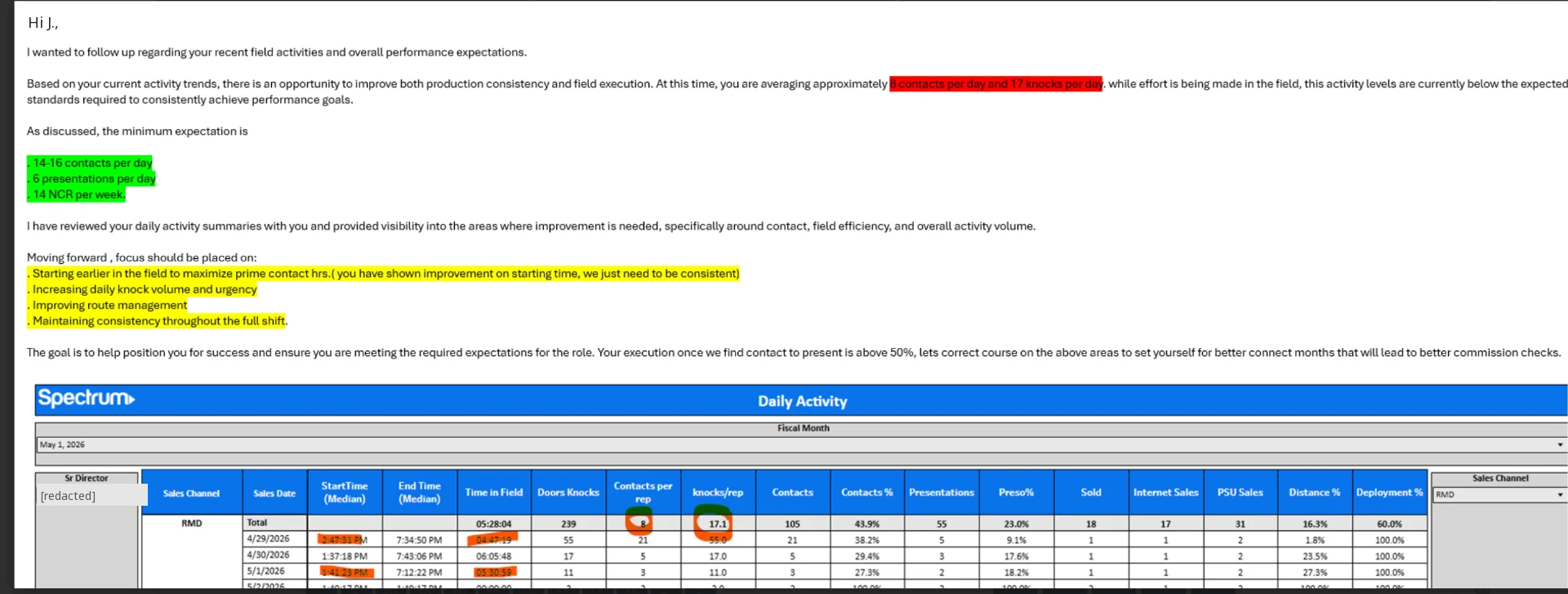
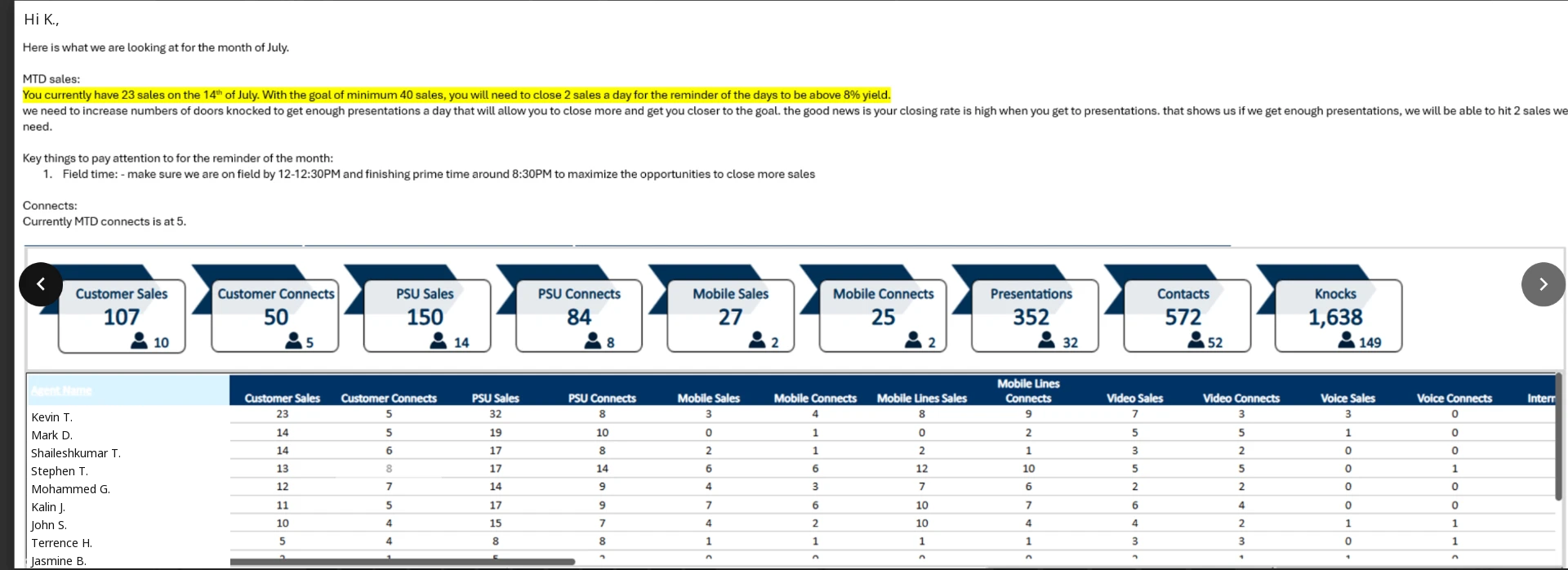
These are two real coaching notes I sent, shown as they went out. They cover the two situations that come up most: someone whose activity is short of the standard, and someone who is mid month and behind pace.
A rep below the activity standard
Field activity and where we go from here
He was working hard but starting late and not getting enough doors in, so the volume never showed up in the numbers.
A rep mid-month, behind pace
Where we are for July
Halfway through the month and short of goal. I wanted him to see the math himself and tell me what he was committing to.

Education
Kennesaw State University
Bachelor of Science, Business Administration